How to Choose the Right Rubber Suction Hose for Your Needs?
Choosing the right Rubber Suction Hose can feel challenging. Many options exist, and the right choice depends on various factors. According to industry expert John Doe, “Selecting the proper rubber hose is essential for optimal performance.” This reflects the importance of making an informed choice.
When evaluating your needs, consider the hose's diameter, length, and material. A well-fitted Rubber Suction Hose ensures maximum efficiency in transporting liquids. It's common for users to overlook these details, leading to inefficiencies. Think about what you'll use it for. Will you need it for water, oil, or other substances?
Many users ignore the quality and compatibility of the rubber. This can cause issues over time. Understanding the specific requirements of your project will guide you. Remember that what's suitable for one application may not work for another. Don't hesitate to consult with experts. Making the right decision today will save you time and money later.

Understanding the Basics of Rubber Suction Hoses
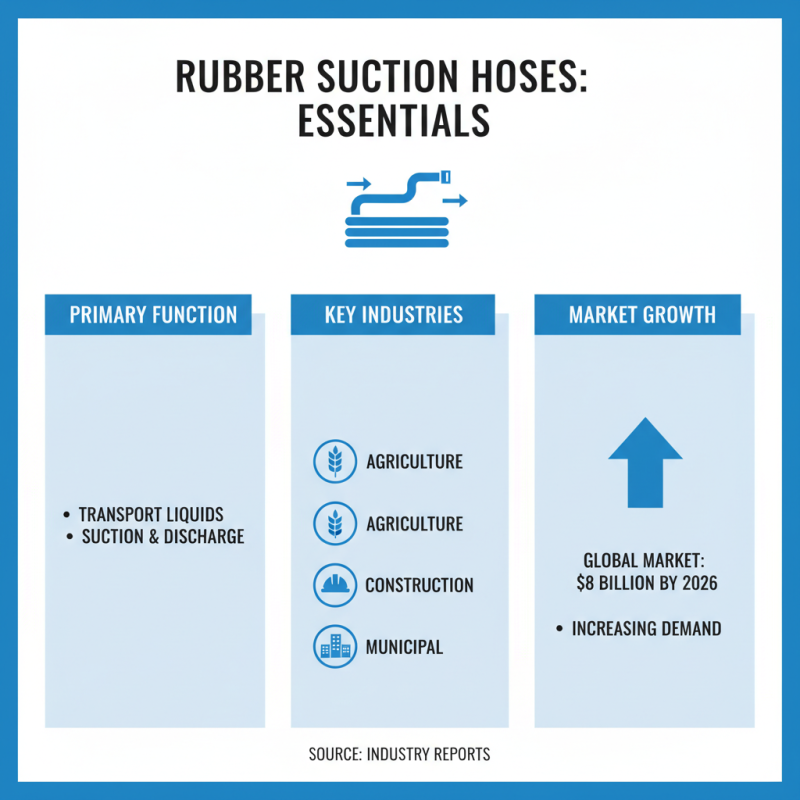
Rubber suction hoses play a critical role in various industries. Understanding their basics is essential for effective usage. These hoses are designed to transport liquids and are vital in agriculture, construction, and municipal applications. According to industry reports, the global rubber hose market is projected to reach USD 8 billion by 2026. This growth reflects increasing demand in several sectors.
When choosing a rubber suction hose, consider the material. Different formulations offer various degrees of flexibility and durability. For instance, reinforcement layers can enhance strength, with some hoses capable of handling pressures up to 150 psi. However, a hose with high pressure ratings may not always be suitable for all applications. A mismatch can lead to operational failures, which could incur significant costs.
Another factor is temperature resistance. Many hoses operate effectively under a wide temperature range, from -10°F to 150°F. Yet, this range might not apply to every hose type. Regular inspection is necessary. Some hoses may degrade faster than expected due to environmental factors. Understanding these elements can guide choices and prevent misapplications, ultimately ensuring better performance and longevity.
Identifying Your Specific Application Requirements
When selecting a rubber suction hose, understanding your specific application is vital. Consider the type of materials you will be transporting. Different hoses are designed for various fluids and solids. If you are dealing with corrosive substances, your choice must reflect that. A hose fails when mismatched. Identifying the temperature range is equally important. High temperatures can degrade certain hoses quickly.
Think about the required diameter and length of the hose. These dimensions affect flow rates and usability. A hose too small restricts movement. A hose too large may be unwieldy. Analyze how far the hose must travel and the angles it needs to navigate. Flexibility matters here, too. Some applications need a rigid structure, while others require a more flexible solution.
Also, consider the pressure ratings of your hose. High-pressure applications demand hoses built to withstand such conditions. However, it’s easy to overlook this detail. Many assume that all hoses can handle pressure equally, but that’s not the case. Misjudging this can lead to leaks or burst hoses. Understand the limitations and strengths of your chosen material. Reflect on your needs, or you could face costly failures in the field.
Evaluating Hose Material and Construction Quality
When choosing a rubber suction hose, material and construction quality are crucial. Rubber types vary in durability, flexibility, and temperature resistance. For instance, EPDM rubber is excellent for hot water applications. It withstands heat well, but it can be less flexible in cold. On the other hand, NBR rubber is resistant to oils but might become brittle over time.
Examining the construction is just as important. Look for hoses with reinforced layers. These can better handle pressure and prevent kinking. The hose's fittings also matter. Poorly designed fittings can lead to leaks. Even small leaks can turn into major issues. Check if the hose is designed for the specific applications you have in mind. It's easy to overlook these details, but they significantly impact performance.
Consider the environment where the hose will be used. Extreme weather can affect its lifespan. Does it need to handle chemicals? Not all hoses are made equal. Sometimes, it’s tempting to choose the cheapest option. Yet, a lower price often comes with compromised quality, leading to frequent replacements. Reflecting on these factors can help you make a better decision.
Determining the Appropriate Size and Diameter
Choosing the right rubber suction hose begins with understanding size and diameter. Correct sizing is crucial for maximizing efficiency. A hose that is too large may lead to a loss of suction. Conversely, if the diameter is too small, it can cause blockages. Industry reports indicate that approximately 30% of suction issues can be traced back to improper hose sizing.
It’s essential to measure the inner diameter of the hose. This can vary based on the application. For example, agricultural operations often require hoses with a larger diameter to facilitate high-volume transfer of liquid. Conversely, industrial applications may focus on smaller diameters that accommodate specific machinery. Tips: Always consult flow rate charts before making a decision. This can help in matching hose size with the pump's capacity.
Don't overlook the length of the hose. Excessive length can also impact performance. A 2022 report suggested that every additional 10 feet can decrease suction efficiency by up to 5%. Consider your setup and measure distances carefully. Tips: Test different configurations to find the best fit. Sometimes, it’s a matter of trial and error. Evaluate your needs critically; the right choice often requires a thoughtful approach.
How to Choose the Right Rubber Suction Hose for Your Needs? - Determining the Appropriate Size and Diameter
| Application |
Hose Diameter (Inches) |
Hose Length (Feet) |
Material Type |
Pressure Rating (PSI) |
| Water Suction |
2 |
50 |
EPDM |
65 |
| Oil Transfer |
3 |
100 |
Nitrile |
75 |
| Vacuum Applications |
1.5 |
25 |
PVC |
30 |
| Chemical Transfer |
2.5 |
40 |
Hypalon |
50 |
Considering Pressure Ratings and Temperature Tolerance
When selecting the right rubber suction hose, pressure ratings and temperature tolerance are key. Each application demand varies. Understanding your requirements will help you make an informed choice. For instance, high-pressure environments need hoses that can withstand those levels. Look for clear specifications that match your working conditions.
Tips: Always consult manufacturer guidelines for temperature ratings. Hoses have limits. Ignoring them may lead to failure. Be cautious with extreme temperatures. Rubber can degrade under certain conditions, affecting performance.
Consider the environment of use. If you're in a hot area, you need a hose that won't warp or lose flexibility. Check the material of the hose. Some blend better with certain liquids and gases. Remember that what works well for one application may not work for another. Each situation requires careful consideration and sometimes trial and error.
Pressure Ratings and Temperature Tolerance of Rubber Suction Hoses